Every day, crews walk into homes and apartments to do construction and trade work, sent there by someone else. Property managers, repair networks, insurance companies, warranty companies, and general contractors all use subcontractors to carry out work in other people’s homes.
Homeowners assume those people are screened, and they almost never are.
Sublynk works with thousands of contractors and observes the operations of thousands more every month. Less than 1% of residential contractors and trades companies screen their subcontractors.
That isn’t because they don’t care. Screening W-2 employees is common, and a requirement for subs to screen their workers is usually built into the agreement between the companies. The problem is that it isn’t enforced or followed through on.
This guide covers the real numbers behind criminal records in the U.S., how fast the odds add up when subcontractors go unscreened, and what real background checks for contractors should include. It’s for homeowners deciding who to let in, and for the contractors, property managers, and networks who send subcontractors into homes every day.
How common are criminal records in the U.S.?
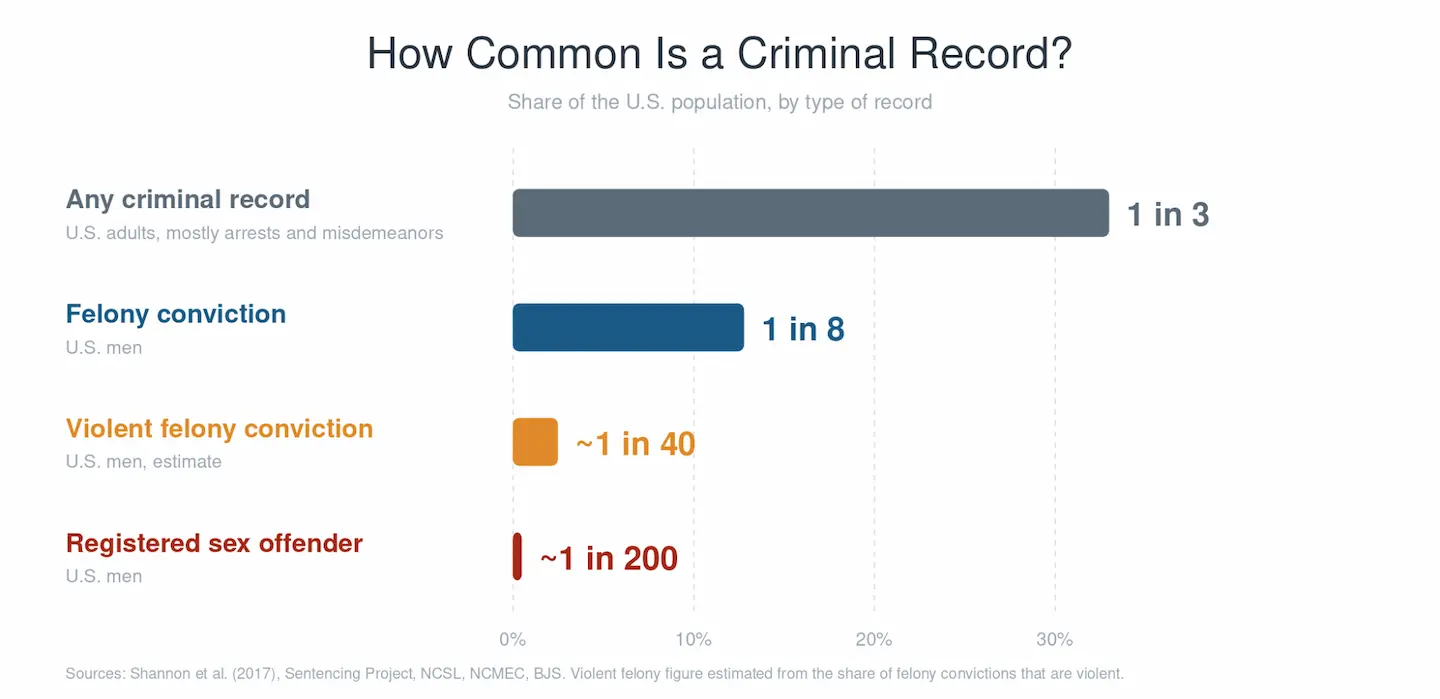
Criminal records are more common than you might expect. Here’s what the public data shows:
- About 1 in 3 American adults has some kind of criminal record. Most of these aren’t serious crimes.
- About 8% of all adults, and roughly 1 in 8 men, have a felony conviction.
- Roughly 2.5% of men have a violent felony conviction.
- More than 1 in 200 men in the U.S. are registered sex offenders.
These figures are for the general population. They aren’t adjusted for hiring in the construction trades, where people with records are more likely to be hired. If anything, the numbers on a jobsite are probably higher.
Does a criminal record make someone dangerous?
Most people with a record aren’t a threat to anyone, and everyone deserves a chance if they’ve made a mistake. Plenty of people with records are great at their trade, show up every day, and deserve the work. Second chances are a big part of what makes the trades work, and that’s a great thing.
The problem isn’t that people with records work in homes. The problem is not knowing.
A ten-year-old possession charge and a violent assault conviction can both be felonies, and without a background check, nobody can tell them apart. The homeowner opening the door assumes the company that sent the crew ran that check. Usually, they didn’t.
Unscreened workers: how the odds add up
Each unscreened worker on their own is a small risk, but most jobs involve far more than one person. A dozen subcontractors with two or three workers each means dozens of people entering homes, and every one of them carries the same odds of having a record.
Those odds don’t change for any one person as you add more workers, but the chance that at least one of them has a record rises quickly, the same way flipping a coin more times makes it more likely you’ll land heads at least once.
Criminal record odds across 30 unscreened workers
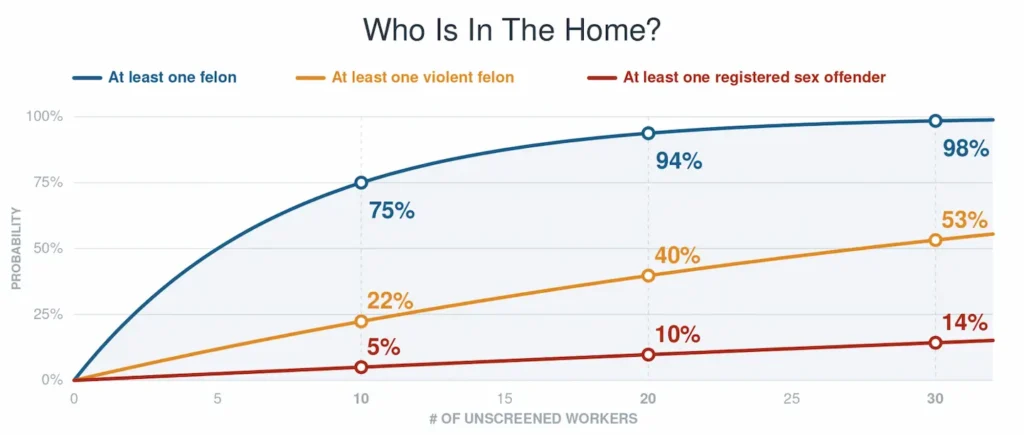
For a homeowner, 30 workers would be a very large remodel. For a GC, property manager, repair network, or warranty company, 30 unscreened subs might be a normal day of dispatches.
With 30 workers, it’s almost certain that at least one has a felony. There’s about a 50% chance at least one has a violent felony. And there’s roughly a 15% chance a convicted sex offender is being sent into a home.
A quick online search shows how these situations can go wrong. They’re rare, but they make the news almost every week, and those are only the ones that get reported.
What a contractor background check should include
Not all background checks for contractors are equal – a cheap online search and a real screening can return very different results.
Because we review background checks across thousands of contractors at Sublynk, we regularly see a felony record show up through one background check company and not appear at all through another.
A solid contractor background check includes:
- County-level criminal searches everywhere the person has lived. County courthouses are where most criminal records actually live.
- A national criminal database search, used as a starting point.
- A national sex offender registry search covering all states.
- Federal criminal searches to catch federal crimes.
These checks should be run on every person who enters a home if you want a clear picture of the risk you’re taking on.
What background checks can miss
Even a thorough background check on contractors has limits.
- National databases aren’t complete. They’re built from whatever counties and states choose to submit, and some court records never make it in.
- Some records have time limits. Under the Fair Credit Reporting Act, arrests that didn’t lead to a conviction generally can’t be reported after seven years. Convictions usually don’t have that limit, although some states set their own limits on reporting convictions.
- A background check is a snapshot. It’s only accurate on the day it’s run, so checks need to be repeated on a regular schedule to stay current.
- Identity matching matters. If a check is run on just a name and date of birth instead of a verified SSN, a common name can pull up the wrong records or miss the right ones entirely.
Questions homeowners should ask before work starts
You don’t need to run a background check on contractors yourself to protect your home. You just need to ask the right questions:
- Does your company run background checks on everyone who will be in my home, including subcontractors?
- What does the check include, and how often is it run?
- Will you give me a list of the screened individuals by name?
- Who do I call if someone not on that list shows up?
A good contractor will have clear answers, and the ones with a process in place will appreciate that you asked.
How to enforce subcontractor screening requirements
If you’re a GC, property manager, network, or home warranty company, you probably already require your subcontractors to be screened. But you likely only require it for the owner, not their crews.
The real work is putting a process in place that makes screening easy so you don’t lose subs over it:
- Screen the people who show up, not just the owner: A check on the owner tells you nothing about the crew.
- Verify, don’t just collect: A clause in a contract isn’t a background check. Confirm the checks were actually done.
- Make it easy on the sub: The more friction you add, the more good subs walk. A simple process that only has to happen once keeps them working with you.
- Decide who pays up front: Unclear cost is one of the biggest reasons screening never happens. Settle it before the first job.
- Make screening a condition of getting work: Subs who haven’t been screened don’t get jobs. In our experience, that’s the only version of the requirement that holds up.
- Set a refresh schedule: A check from three years ago tells you nothing about today.
- Keep it all in one place: Your process should be easy for subs, but it should also be easy for your internal staff to run, reference, and audit.
Use screening to win more business
Once screening is in place, it stops being just a cost and becomes something you can sell. Imagine sitting in front of every homeowner and saying:
“We operate differently. Everyone who walks into your home will be screened, and I’ll give you a list of their names. This level of screening means we’ll probably cost more than our competitors. If you choose not to work with us, please ask whoever you hire for the same level of screening. You don’t want unscreened workers walking into your home.”
That’s a mic drop moment. None of your competitors do it.
How Sublynk helps your business run contractor background checks
Sublynk is a vetted contractor network built for trades businesses, GCs, contractor networks, property managers, warranty companies, and any business that uses subcontractors and vendors. We help source, vet, and manage contractors at scale.
Sublynk is built to fix the reasons screening doesn’t happen. We make it easy and affordable, and we make sure the subcontractor or vendor only has to do what’s absolutely necessary while we take care of the rest.
Our approach removes the friction that makes subs walk. It settles the question of who pays for what. It also turns the screening requirement in your contract into an advantage over your competitors.
What Sublynk verifies
- Background checks through every layer, covering the owner and the crew members who actually do the work.
- Screened once, shared everywhere: A sub’s screening and credentials travel with them to every GC and network they work with on Sublynk.
- Business verification, including ownership, entity status, liens, and bankruptcy.
- License verification at the source.
- Insurance verification at the source, including the endorsements your contracts require, like waivers of subrogation.
- AI review with human QA: AI agents review every document, and our team reviews every flag.
Businesses that need contractors use Sublynk for free. Contractors pay one flat monthly subscription, with no lead fees or commissions.
Frequently asked questions
Do contractors run background checks on their subcontractors?
Rarely. Many GCs and networks write a screening requirement into their subcontractor agreements, but it’s seldom enforced.
What are red flags on a contractor background check?
For in-home work, the biggest concerns are violent felonies, sex offender registration, and recent theft, burglary, or fraud convictions. Identity problems are also a warning sign, like an SSN that doesn’t match the name.
Are free online background checks for contractors good enough?
No. Free and low-cost people-search sites pull from incomplete databases and usually match on name alone. That means they can miss records entirely or attach someone else’s history to the wrong person.
I am a contractor, can I use Sublynk to screen my subcontractors?
Yes. Sublynk is built to help contractors source, vet, and manage subcontractors at scale.
If I vet and screen my subcontractors through Sublynk how can it become a competitive advantage?
Sublynk provides GC's with a public page that displays their verified credentials, insurance, and the names of their personnel and subs that have verified background checks on file. That page can be used as a link on your website or business cards used in the field. Challenge homeowners and customers to ask if your competitors can provide the same level of transparency – they can't.